Manufacturing Design Using DFM to Reduce Costs in CNC & Injection Moulding
Modern manufacture is no more about making parts; rather, it’s all about producing them efficiently, accurately, and cost-effectively. One of the powerful strategies used by successful manufacturers in the present world is the technique of design for manufacturability.
DFM in designing parts includes easy manufacture, fast production, and lower cost without sacrificing quality or performance. DFM is vital in the industries for reducing errors, minimizing rework, and optimizing costs of production in both CNC machining and injection moulding.
Below is a blog explaining what DFM is, why it matters, and how it directly reduces cost in CNC machining and injection moulding projects.
🧠 What Is Design for Manufacturability?
Design for Manufacturability, or DFM for short, is a methodology in engineering where product designs and designs for manufacture are brought into focus right from the conceptual stage. Hence, rather than taking a design route and then working towards resolving manufacture-related issues, their integration takes place in a single step.
When considering production technology, equipment, and materials, in addition to cost considerations early on, DFM assists in overcoming delays in production.
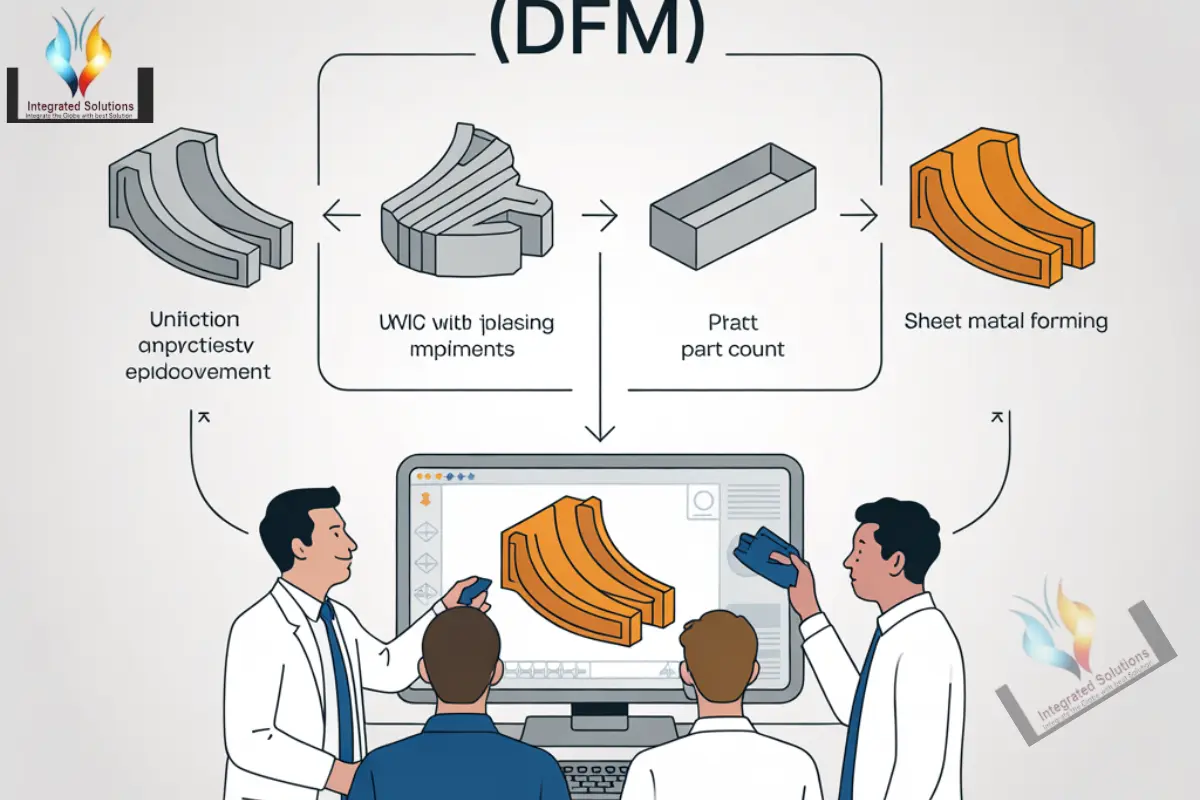
Design for Manufacturability in CNC and Injection Moulding
⚙️ Why DFM Is Critical in CNC Machining
CNC machining delivers high accuracy and repeatable results, but without proper Design for Manufacturability (DFM), even simple parts can become unnecessarily expensive to produce.
When a design is not optimized for machining, it often results in longer cycle times, excessive tool wear, increased scrap rates, and higher production costs. DFM helps prevent these issues by aligning the part design with machining capabilities from the start.
🔍 Common CNC Machining Design Problems Without DFM
Without applying DFM principles, CNC-machined parts often face avoidable design challenges such as:
🎯 Unnecessarily tight tolerances
Tight tolerances increase machining time and inspection cost when they are not functionally required.🕳️ Deep pockets with sharp internal corners
These require special tooling and slow machining, increasing tool wear and cycle time.📏 Thin walls and fragile features
Thin sections can vibrate, deform, or break during machining, leading to scrap parts.🔄 Complex geometries needing multiple setups
More setups mean longer production time and higher chances of alignment errors.🧩 Non-standard hole sizes
Custom tooling is often required, increasing cost and reducing machining efficiency.
🛠️ How DFM Improves CNC Machining Cost
One of the most important benefits of Design for Manufacturability (DFM) is cost reduction in CNC machining. Designing parts in a manner consistent with machining capabilities removes unnecessary complexity.
⏱️ 1. Machining Time
DFM targets designing a part that is faster and simpler to machine by using these methods:
- 🧰 Common tool sizes
- 📐 Simple and machinable geometries
- ⚙️ Optimized tool paths
When designs incorporate these guidelines, CNC machines can accomplish tasks in a faster manner, thus lowering machine time and machining hours.
🔧 2. Reduced Tool Wearing and Breaking
Tooling expense is a big factor in CNC machining. DFM assists in tool protection in order to make sure designs do not violate these factors:
- cutter diameter restrains
- proper depth-to-width proportions
- material machinability
This results in:
- 🛡️ Increased tool life.
- 💰 Less expense in replacing tools.
- 🚫 Less unexpected tool breakage.
📐 3. Optimized Tolerances Where Needed
Not all characteristics need to have very tight tolerances. DFM will:
- 🎯 Tight tolerances are used only where they are functionally necessary.
- 📏 relaxed tolerances are used elsewhere.
This approach:
- decreases machining time and inspection time
- enhances production output
- reduces total production cost
🔄 4. Fewer machine setups
Every subsequent setup adds to labor, time, and possibility of error. DFM facilitates:
🧩 Single setup machining if possible
🔁 Better part orientation
🛠️ Easier fixtures
A reduced number of setups translate to quick production time, accuracy, and cheap machining.
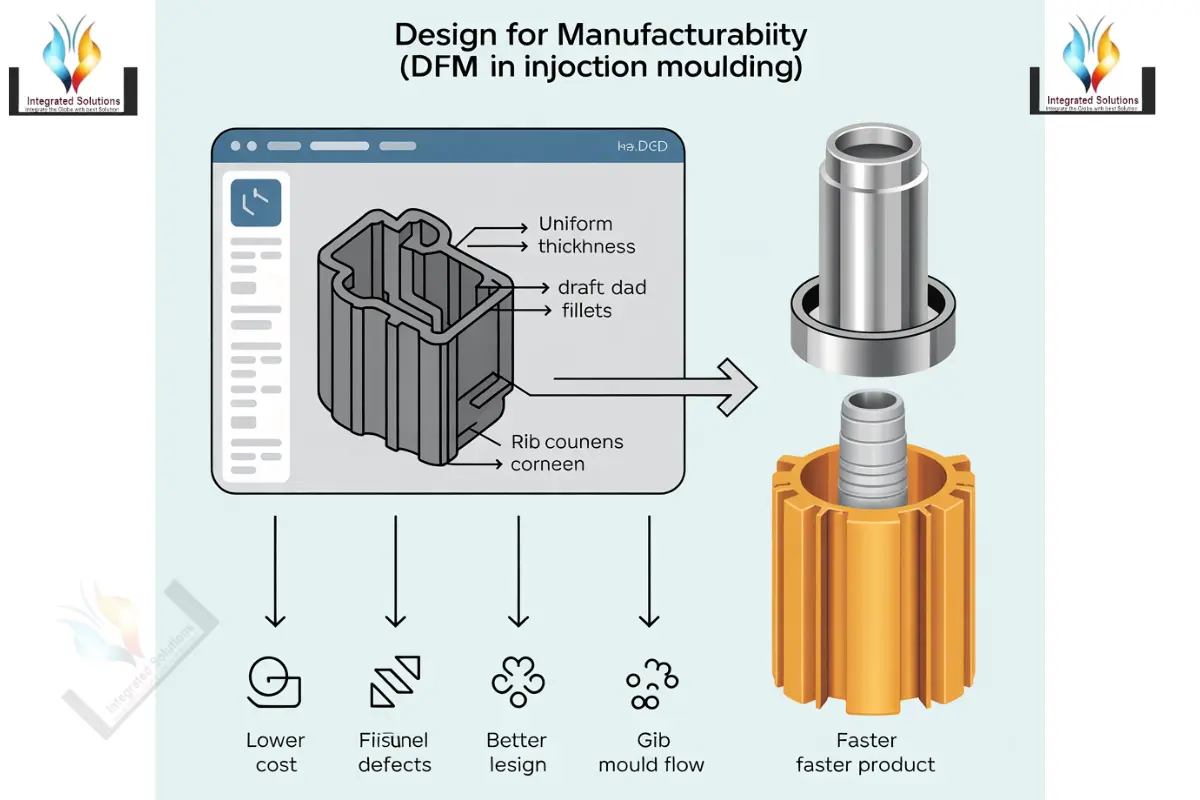
Role of DFM in Injection Moulding
🧩 Role of DFM in Injection Moulding
Because of the high investment in tooling associated with injection moulding, Design for Manufacturability (DFM) is particularly important. Complex plastic parts that have not been designed with moulding constraints in mind often require many mould modifications and higher tooling costs, delaying production.
DFM ensures that plastic parts are designed from the very first mould trial to fill, cool, eject, and perform correctly, reducing risk while improving overall efficiency.
⚠️ Common Injection Moulding Problems Without DFM
Without proper DFM analysis, injection-moulded parts commonly suffer from the following issues:
📏 Uneven wall thickness
Causes sink marks, voids, and inconsistent part strength.📐 Sharp internal corners
Create stress concentration points that can lead to cracking or part failure.🔄 Insufficient or poor draft angles
Make part ejection difficult, increasing wear on the mould and risking part damage.❄️ Inconsistent cooling design
Leads to warpage, dimensional instability, and poor surface finish.🧩 Complex undercuts
Require sliders or lifters, significantly increasing mould complexity and cost.
🏗️ How DFM Lowers Injection Moulding Cost
Design for Manufacturability (DFM) plays a major role in controlling and reducing injection moulding costs. By addressing moulding requirements during the design stage, DFM helps avoid expensive tooling changes and inefficient production.
📏 1. Uniform Wall Thickness
DFM promotes consistent wall thickness across the part, which:
🔄 improves material flow during mould filling
⏱️ reduces cycle time
🚫 prevents shrinkage, sink marks, and voids
Uniform walls lead to better-quality parts and more stable production.
📐 2. Proper Draft Angles
Adequate draft angles are essential for smooth part ejection. DFM ensures designs include:
🔄 easy and reliable part release
🛠️ reduced mould wear
✨ protection of surface finish
This directly extends mould life and lowers maintenance costs.
💨 3. Optimized Material Usage
DFM helps engineers choose:
🧪 the correct plastic material grade
🧩 ribbed structures instead of thick solid walls
This approach:
reduces material consumption
maintains required strength and stiffness
lowers per-part production cost
🧪 4. Fewer Tool Modifications
When DFM principles are applied early in the design process:
🔁 fewer mould trials are required
✏️ design changes are minimized
🚀 production can start faster
Reducing tool modifications saves time, money, and project risk.
📊 CNC Machining vs Injection Moulding DFM Cost Impact
| 🧩 DFM Factor | ⚙️ Impact on CNC Machining | 🏗️ Impact on Injection Moulding |
|---|---|---|
| Geometry Simplification | ⏱️ Faster machining cycles with simpler tool paths | 🛠️ Lower mould complexity and reduced tooling cost |
| Tolerance Optimization | 📏 Reduced inspection time and measurement cost | 🎯 Improved part consistency and dimensional stability |
| Material Selection | 🔧 Improved machinability and extended tool life | ❄️ Reduced shrinkage and warpage during cooling |
| Tool Accessibility | 🛡️ Less tool wear and fewer tool changes | 🏭 Longer mould life and reduced maintenance |
| Process Planning | 🔄 Fewer machining setups and faster production | ⚡ Shorter cycle time and improved production efficiency |
🔗 Design + Manufacturing Collaboration
One of the most powerful advantages of DFM is that it fosters cross-functional collaboration between design and manufacturing teams. When teams collaborate from the very beginning, the chances of creating an end product that is not only well-designed but also cost-effective and easy to manufacture are higher.
🤝 Benefits of Collaboration Through DFM
When design and manufacturing teams collaborate, effective supply:
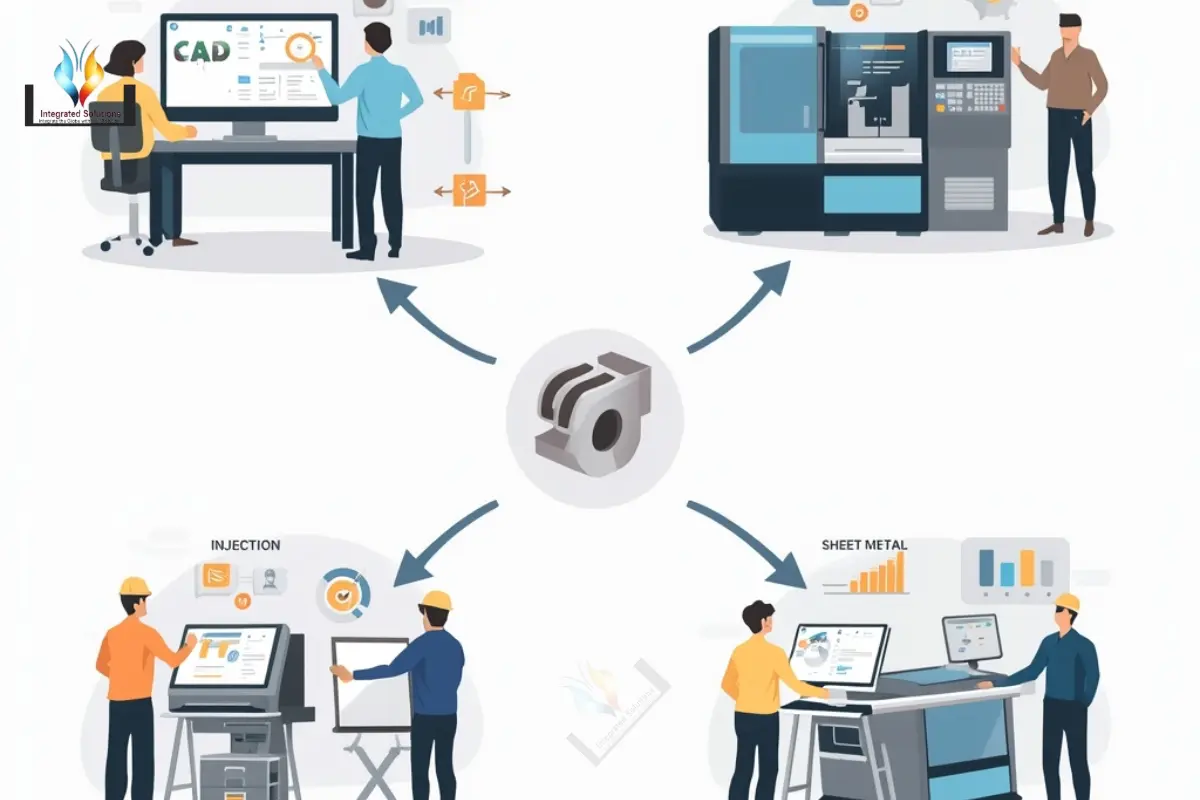
Design + Manufacturing Collaboration
🔍 Identify manufacturing issues early to avoid costly errors before production begins.
⚡ Design changes faster & cheaper-reducing costly redesigns.
⏳ Avoid production delays by smoothly coordinating projects on schedule.
💰 Improve cost estimation – Early manufacturing input ensures accurate budgeting.
🏭 Why Integrated Design & Manufacturing Services Gain the Most
DFM-driven workflows will consequently yield a lot of benefits when there is one roof for both design and manufacturing services. The integration develops advantages in the businesses by making decisions faster, improving product quality, and achieving predictable production timelines, thereby giving a competitive edge to the businesses in the market.
🧪 DFM, Simulation, and Validation
Modern Design for Manufacturability (DFM) goes beyond assumptions—it leverages CAE simulation and manufacturing validation to predict how parts will perform in the real world. This approach ensures that products are optimized for both design and production before they reach the shop floor.
🔍 Key Examples of Simulation-Driven DFM
⚙️ Stress analysis for thin CNC features – Prevents deformation and tool failures.
🧩 Mold flow simulation for plastic parts – Ensures uniform filling and reduces defects.
❄️ Cooling and warpage prediction – Maintains dimensional accuracy and surface quality.
🛠️ Tool path verification – Optimizes machining strategies and reduces cycle time.
By using simulation-driven DFM, engineers can catch potential manufacturing issues early, avoiding costly rework, minimizing scrap, and saving both time and money. This method bridges the gap between design and production, creating more reliable and manufacturable parts.
🚀 Benefits of DFM-Driven Manufacturing to Businesses
Design for manufacturability, or DFM, can bring immense benefit to an organization in terms of cost savings and time savings during production.
📉 Cost Reduction
DFM assists in cost savings by:
💰 Reduced cost of tooling: Fewer rounds of revisions and simpler designs.
♻️ Reduced scrap and rework – Waste less materials and manpower.
⚙️ Optimized machine usage – Smarter tool paths and tooling improve processing time.
📈 Increased Speed to Market
By incorporating design with manufacturing early, DFM brings in:
✏️ Fewer design iterations – Problems are detected in the early stage.
✅ Easier production approval – Designs are available for production earlier.
🚀 Rapid scaling from prototype to production – Reduced lead times in getting market-ready parts.
🏆 Better Product Quality
DFM ensures production of parts with high quality because:
📏 Dimensions constant – Holds a tight tolerance when necessary.
✨ Better surface finish: Reduces defects in machining or molding.
⚡ Reduced Functional Failures – The components work well under real-world operating environments.
🔁 Scalable Manufacturing
The design can be transferred to production with a continuous and seamless transition when optimized using.
🧪 Prototype → Low-volume → Mass production.
Ensures repeatable quality and cost-effective scaling.
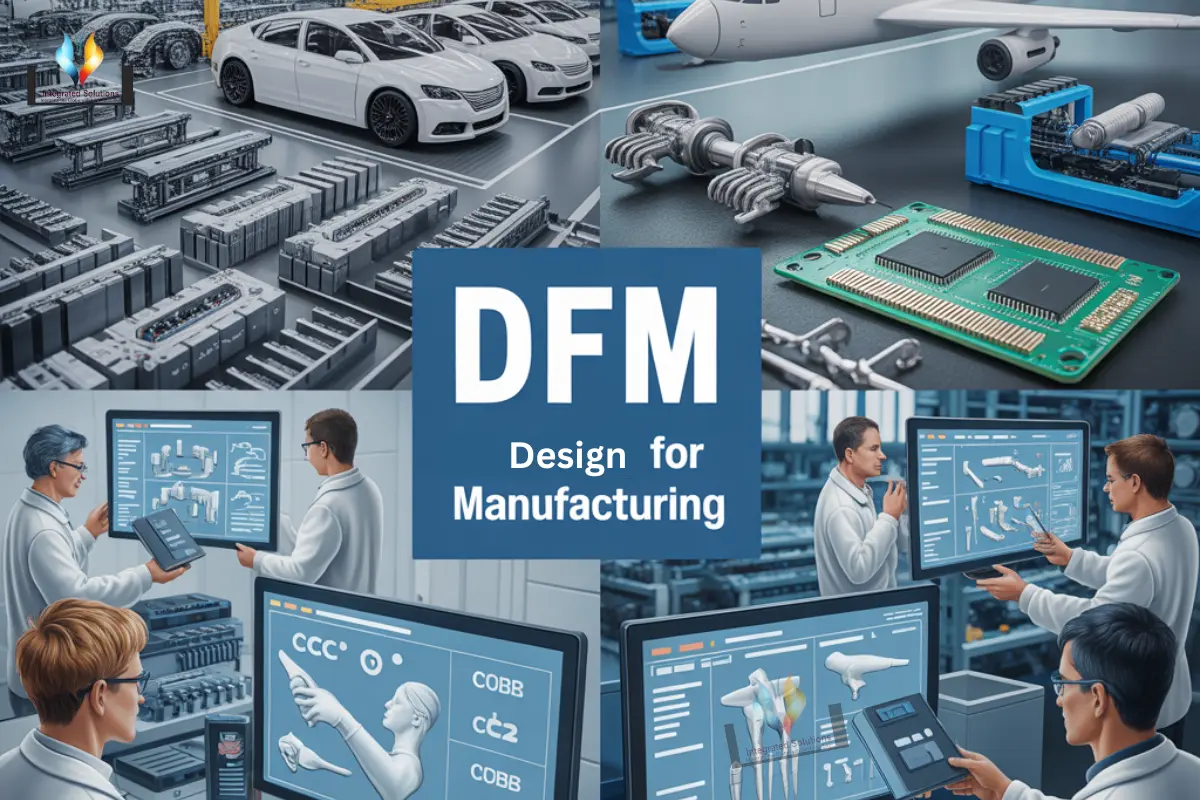
Industries That Benefit Most from DFM
🏭 Industries That Benefit Most from DFM
Design for Manufacturability (DFM) is valuable across multiple industries where cost efficiency, product quality, and speed-to-market are critical. By integrating DFM principles, companies can reduce manufacturing costs, minimize rework, and improve product reliability.
⚙️ Key Industries Leveraging DFM
🚗 Automotive components – Engine parts, brackets, and assemblies with tight tolerances.
🏭 Industrial machinery – Precision parts and complex assemblies for manufacturing equipment.
🛍️ Consumer products – Durable, high-quality items produced efficiently at scale.
🧩 Plastic and rubber parts – Injection-moulded and elastomer components optimized for production.
📐 Sheet metal components – Bent, stamped, or laser-cut parts with minimal rework.
⚡ CNC-machined precision parts – Complex geometries that require careful tooling and setup.
🌟 Why DFM Works Across Industries
Design for Manufacturability (DFM) finds application in all industries where cost, quality, and speed of production matter. Implementing DFM principles in the early design stage will allow companies to benefit from:
⚡ Shortened product development cycles – Identification of production difficulties can quickly speed up the design cycle.
💰 Cost of manufacture and tooling – Reduced because optimized designs cut waste, tooling changes, and scrap.
🏆 Higher consistency and reliability – The production of parts will be of higher accuracy, with less defects and better quality.
The DFM strategy will make sure that the end product is efficient, cost-effective, and scalable.
Frequently Asked Questions
What is Design for Manufacturability (DFM)?
Design for Manufacturability is an engineering approach that ensures product designs are optimized for easy, cost-effective, and efficient manufacturing.
How does DFM reduce CNC machining cost?
DFM reduces CNC machining cost by simplifying geometry, optimizing tolerances, reducing machining time, and minimizing tool wear.
Why is DFM important in injection moulding?
DFM helps control wall thickness, draft angles, material flow, and tooling complexity, which reduces mould cost and prevents defects.
Can DFM improve product quality?
Yes, DFM improves dimensional accuracy, consistency, surface finish, and reduces manufacturing defects.
Does DFM help reduce production time?
DFM reduces production time by minimizing rework, avoiding tooling changes, and improving manufacturing efficiency.
Is DFM useful for both prototype and mass production?
Yes, DFM is useful for prototypes as well as large-scale production by ensuring designs are scalable and cost-efficient.
What industries benefit most from DFM?
Automotive, CNC machining, plastic moulding, industrial equipment, and consumer product industries benefit significantly from DFM.
How early should DFM be applied in product development?
DFM should be applied at the early design stage to avoid costly changes during manufacturing.
Does DFM reduce tooling and mould modification cost?
Yes, DFM reduces tooling rework and mould modifications by addressing manufacturing challenges before production.
Can DFM be combined with CAD, CAM, and CAE?
Yes, DFM works best when combined with CAD for design, CAE for simulation, and CAM for manufacturing planning.